How to Start a Dog Grooming Business in the UK (2026)
Last updated:
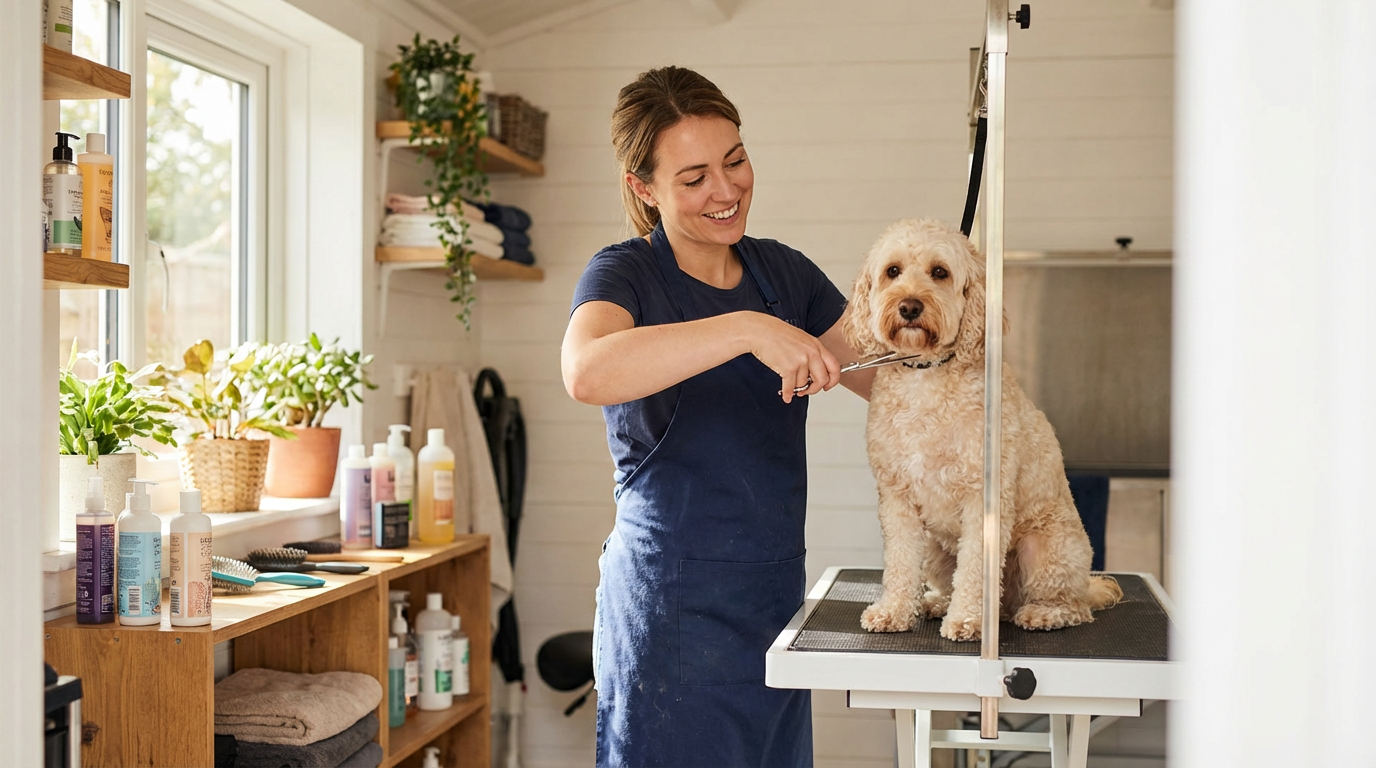
Starting a dog grooming business in the UK is more achievable than most people think — but getting it right takes more than a set of clippers and a willing spaniel. You need qualifications, insurance, somewhere to work, a way to take bookings, and a plan for finding clients. This guide covers all of it, with UK figures, UK legislation, and no advice lifted from American websites.
What do you need to start a dog grooming business in the UK?
- Qualifications — not legally required, but City & Guilds Level 2 or 3 (or iPET Network equivalent) is strongly recommended
- Public liability and animal liability insurance — before you groom a single dog; budget £200–£400/year
- Equipment — grooming table, professional clippers, scissors, dryers, bathing setup, brushes; £2,500–£7,000 for a home setup
- HMRC registration — register as a sole trader and set up Self Assessment before you start trading
- A place to groom — home salon, mobile van, rented table in an existing salon, or commercial premises
- Booking and payment system — to take bookings, collect deposits, and send automated reminders from day one
- Clients — Google Business Profile, Tuft marketplace, local Facebook groups, and word of mouth
Full detail on each of these is below.
Do You Need Qualifications?
Here’s the straight answer: technically, no. Dog grooming is currently unregulated in the UK, which means there’s no law requiring you to hold a qualification before taking paying clients.
But here’s why you should get one anyway. A formal qualification makes you a better groomer — handling anxious dogs, working safely with different coat types, recognising skin conditions are real skills that take training. It also matters to clients, many of whom ask about qualifications before booking. And it affects your insurance: some specialist insurers require formal training.
Which qualifications are worth getting?
City & Guilds Level 2 and Level 3 in Dog Grooming are the most widely recognised in the UK. Level 2 covers the basics — breed knowledge, grooming techniques, health and safety. Level 3 goes deeper into advanced styling and business skills.
iPET Network qualifications are also well-regarded. Their Level 3 Certificate is offered by training providers across the country.
The British Dog Groomers’ Association (BDGA) membership isn’t a qualification but signals professional standards that some clients actively look for.
If you’re starting out, a recognised Level 2 from an accredited provider is the minimum. If you’re serious about building a reputable business, Level 3 is the right goal.
The Legal and Regulatory Stuff
Nobody’s favourite topic. But you need to sort this before you take your first client.
Business structure
Most new groomers register as a sole trader — it’s simpler and cheaper. You register with HMRC for Self Assessment and keep records of income and expenses. A limited company offers more protection but comes with more admin and cost.
Insurance
This is not optional. You need public liability insurance and animal liability insurance before you groom a single dog. Most specialist pet business insurers package these together. Providers commonly used by UK groomers include Protectivity, Cliverton, and Petplan Sanctuary. Budget around £200–£400 per year.
If you’re working from home, check your home insurance — standard policies usually won’t cover commercial activity. Mobile groomers: your standard car insurance won’t cover business use either.
Planning permission
If you’re changing the use of part of your home to a business — especially with regular client visits — you may need planning permission. Check with your local planning authority and notify your mortgage lender or landlord.
GDPR
You’ll be collecting client data: names, addresses, pet information, payment details. Only collect what you need, keep it secure, and have a simple privacy policy. The ICO has free guidance at ico.org.uk.
Choosing Your Business Model
Before you spend a penny on equipment, decide what kind of grooming business you’re actually opening. Each model has different costs, challenges, and clientele.
| Model | Startup Cost | Pros | Watch out for |
|---|---|---|---|
| Home-based salon | £2,500–£7,000 | Lowest cost, no commute, total control | Planning permission, mortgage/landlord consent, home insurance |
| Mobile van | £17,000–£48,000 | Premium pricing, no premises, one-to-one service | High upfront cost, route logistics, vehicle maintenance |
| Table rental | £50–£200/week + kit | No premises overhead, ready-made footfall | Commission splits, no control over environment |
| Commercial salon | £10,000–£30,000+ | Most professional, can take on staff | Highest financial risk, ongoing rent before revenue |
Many groomers combine models — start home-based, add mobile appointments later, move into commercial premises once revenue is consistent.
Starting a dog grooming business from home
Running a grooming business from home is the most common starting point in the UK. The upfront cost is far lower than opening a commercial salon or buying a van, and you’re not paying rent before you’ve built a client base. A spare room, garage conversion, or purpose-built garden room all work well.
What you need to set up at home: a grooming table, a professional bath with shower head and non-slip mat, a force dryer, clippers, scissors, and adequate drainage. The room needs good ventilation, non-slip flooring, and enough space to safely handle dogs of different sizes.
Before you take your first client at home: confirm your home insurance covers commercial activity (most standard policies don’t), notify your mortgage lender or landlord, and check whether you need planning permission. Many home-based groomers are fully booked within their first year through Google Business Profile and word of mouth alone.
Dog grooming business ideas: which model fits you?
Home-based salon suits groomers who want low overhead and a consistent local client base. Mobile grooming van appeals to those who prefer one-to-one appointments and premium pricing. Table rental is the lowest-risk entry point. Commercial salon makes sense once you want to take on staff. And for those who’ve built a strong reputation, training other groomers can become a meaningful revenue stream alongside the day-to-day work.
Startup Costs: Realistic UK Figures
Home-based salon
| Item | Approx. Cost |
|---|---|
| Grooming table (hydraulic or electric) | £300–£800 |
| Professional dryers (force + stand) | £300–£800 |
| Bath and restraints | £200–£600 |
| Clippers, blades, scissors | £500–£1,200 |
| Shampoos, conditioners, finishing products | £200–£400 |
| Room setup (storage, flooring, lighting) | £500–£2,000 |
| Insurance | £200–£400/year |
| Booking software | £0–£400/year |
| Qualifications (if not yet done) | £1,000–£3,000 |
| Total (without qualifications) | £2,400–£6,800 |
Mobile grooming van
| Item | Approx. Cost |
|---|---|
| Vehicle (second-hand van or trailer) | £8,000–£25,000 |
| Van conversion (table, bath, dryer, plumbing) | £5,000–£15,000 |
| Equipment and tools | £1,500–£3,000 |
| Insurance (vehicle + business) | £800–£1,500/year |
| Qualifications | £1,000–£3,000 |
| Website and booking software | £200–£600/year |
| Marketing (initial) | £200–£500 |
| Total | £17,000–£48,000 |
You can start more modestly with a second-hand trailer and basic equipment, then reinvest as you grow.
Equipment: What You Actually Need
It’s easy to spend a fortune on things you don’t need yet. Here’s what you genuinely can’t do without on day one.
The essentials
Grooming table. A proper table at the right height protects your back and gives you control. An adjustable hydraulic or electric table is worth the investment.
Professional clippers. Consumer clippers won’t hold up to daily use. Heiniger, Andis, and Wahl Professional are widely used by UK groomers. Always have a backup pair.
Scissors and thinning shears. Start with straight scissors, curved scissors, and thinning shears. This is an area worth spending properly.
Dryers. A force dryer for blasting excess water, plus a stand dryer for finishing. A force dryer alone is the minimum.
Bathing setup. A proper grooming bath with non-slip mat, shower head, and restraint system.
Shampoos and conditioners. A general shampoo, a whitening shampoo for lighter coats, and a conditioner as a starting set.
Brushes and combs. Slicker brushes, pin brushes, and a range of combs — you’ll use these constantly.
What can wait
Heated drying cabinets, specialist breed tools, premium styling accessories — all nice to have, none of them day-one necessities. Buy quality where it matters (clippers, scissors, table) and keep it simple on everything else.
How Much Can You Earn as a Dog Groomer in the UK?
This is what most guides gloss over. Let’s be direct about it.
These are gross figures before tax and expenses. A groomer seeing 5–6 dogs a day at £60–£80 each generates £1,500–£2,400 per week. A well-run home-based business can generate £35,000–£55,000 in gross profit per year once established.
UK earnings by region
| Region | Typical day rate (4–6 dogs) | Est. annual earnings |
|---|---|---|
| London | £350–£550 | £40,000–£58,000 |
| South East | £280–£420 | £35,000–£50,000 |
| South West | £240–£360 | £30,000–£44,000 |
| East of England | £240–£360 | £29,000–£44,000 |
| East Midlands | £220–£320 | £27,000–£40,000 |
| West Midlands | £220–£320 | £27,000–£40,000 |
| North West | £200–£300 | £25,000–£38,000 |
| Yorkshire | £190–£290 | £23,000–£36,000 |
| Wales | £185–£280 | £23,000–£35,000 |
| Scotland | £195–£290 | £24,000–£36,000 |
| Northern Ireland | £170–£250 | £21,000–£31,000 |
What actually drives your income
How many dogs you see per day. Most solo groomers manage 4–6 full grooms comfortably. The goal is 5 dogs a day at a price you’re proud of — not rushing through 8 at a rate that undervalues your work.
Your pricing. Don’t anchor yourself to the cheapest option locally. A qualified groomer doing excellent work isn’t the same product as an unqualified one charging £30.
No-shows. A no-show isn’t just the cost of one appointment — it’s an empty slot you could have filled. Tuft‘s deposit rules reduce no-shows by up to 89%.
Repeat clients. A client who books every 6–8 weeks is worth far more than the average once-a-year pet owner. Build recurring bookings into your system from the start.
UK Tax and HMRC: What You Need to Know
Most guides skip this entirely. The ones that cover it are American and irrelevant to UK groomers. Here’s the actual situation.
Registering as self-employed
As soon as you start trading, register for Self Assessment with HMRC at gov.uk/set-up-sole-trader. You’ll receive a UTR (Unique Taxpayer Reference). Your first return covers your first full tax year (April to April), due by 31 January.
National Insurance
You’ll pay Class 4 National Insurance — 6% on profits between £12,570 and £50,270 for 2025/26, and 2% above that.
Income tax
You pay 20% on profits between £12,570 and £50,270 (the first £12,570 is tax-free). Above £50,270, the 40% higher rate applies. On £35,000 profit you’re paying tax on about £22,430 — roughly £4,500/year.
VAT
You only need to register for VAT once your taxable turnover exceeds £90,000 in any 12-month period (2025/26 threshold). Most solo groomers won’t hit this early on.
What you can claim as expenses
- Professional insurance (public liability, animal liability)
- Equipment and tools (clippers, scissors, tables, dryers)
- Consumables (shampoos, conditioners, gloves, cleaning products)
- Training and professional development
- Mileage — 45p per mile for the first 10,000 miles/year, 25p above that
- A proportion of home bills if you work from home
- Booking software and subscriptions
- Marketing costs (website, photography, social media ads)
- Professional memberships (BDGA, etc.) and accountant fees
Keep receipts for everything. See the full list at gov.uk/expenses-if-youre-self-employed.
Writing Your Dog Grooming Business Plan
A business plan doesn’t need to be a hundred pages. For a small grooming business a few well-thought-out pages will do. The point isn’t the document — it’s the thinking it forces you to do before you spend anything.
What to cover
Your niche. Are you specialising in a particular breed? Offering evening and weekend slots? Focusing on anxious dogs turned away elsewhere? A clear niche makes your marketing easier and your reputation stronger.
Market analysis. How many groomers within two miles, and what are they charging? Are there gaps — no mobile option, no evening slots, no breed specialists?
Services and pricing. UK pricing in 2026 runs from £30–£45 for a bath and dry on a small dog to £65–£120+ for a full groom on a larger breed. For a detailed breakdown, see the UK dog grooming pricing guide.
Financial projections. At £65 average and 5 dogs a day, 5 days a week, that’s £1,625/week gross. Work backwards from there.
Startup costs. Use the tables above. Know exactly how much you need and where it’s coming from before you spend anything.
How to Get Your First Clients
Here’s what actually works for a new UK grooming business.
Get listed everywhere
Google Business Profile is non-negotiable. Create and verify your listing, add photos, set your services and prices. This is how most people find local groomers.
Tuft marketplace. Getting your profile set up on the Tuft marketplace puts you in front of over 100,000 pet owners actively looking to book groomers in their area. Pet owners book directly through the app — so it converts into actual appointments, not just visibility.
Facebook and Instagram. Post before-and-after photos and make it crystal clear where you’re based and how to book. Breed-specific content does particularly well: if you specialise in goldendoodle grooming, cockapoo grooming, or schnauzer grooming, say so clearly.
Online directories. Yell.com, Bark.com, FreeIndex. Takes an hour to set up and the long-tail value compounds over time.
Ask for referrals early
A small incentive — a discount on their next appointment, a free nail trim — makes people much more likely to recommend you. Word of mouth is slow to build but becomes your cheapest and most reliable marketing over time.
Build relationships with vets and pet shops
A good relationship with a local vet or pet shop can generate a steady stream of referrals. Introduce yourself, drop off cards, and offer a reciprocal arrangement if it feels right.
Build your portfolio fast
Offer a discounted rate (not free — value matters) for your first few weeks in exchange for before-and-after photos and a testimonial. People book based on proof that you can do the work.
Setting Up Your Booking System
Starting with a paper diary or WhatsApp feels fine at first. Then the cracks appear: clients booking at 10pm, double-bookings, no-shows, and an hour every evening confirming appointments by text. Get this right from the start.
Good booking software for dog groomers should handle online booking, automated reminders via SMS/email/push, deposit collection at the point of booking, pet profiles with breed and coat type, consent forms for clip-offs, and integrated payments.
We’ve compared every option UK groomers actually use, prices and honest verdicts included, in our guide to the best dog grooming software.
Tuft — Built for UK Groomers
Free to start, no booking caps
Tuft is dog grooming booking software built specifically for the UK market — GBP pricing, UK payment processing through SumUp, and UK support. The Essential tier is genuinely free forever (not a trial), with no booking caps and no support restrictions.
What’s included free
Calendar, bookings, automated email and push reminders, deposit rules (reduces no-shows by up to 89%), per-pet profiles with breed and coat type, clip-off consent forms, cash/card/SMS/in-app payments, and a listing on the Tuft pet owner marketplace (100,000+ registered pet owners).
Pro features (£35/month, or £29/month paid annually, + VAT)
Unlimited SMS, recurring bookings at 6, 8, or 12-week intervals, the groomer mobile app (iOS and Android), web booking widget for your own site, breed classification overrides, and daily data backups. 14-day free trial, no contract, reverts to Essential if you don’t upgrade.
Payment processing
Online payments and deposits through Ryft at 2.5% + 5p per transaction. In-person card payments via integrated PAX reader at 1.58% or SumUp at 1.69%. 0% commission on salon bookings. Money goes directly to your bank account.
Growing Your Business
Once you have your first clients and a reliable booking system, growth is about two things: retention and referrals.
Retention means making sure every client’s experience is good enough that they keep coming back and tell their friends. That’s not just the quality of the groom — it’s professionalism, communication, reliability, and making the whole experience easy.
Referrals are the most cost-effective marketing you’ll ever do. Build a system for actively asking for referrals — and rewarding people who give them — and it compounds over time.
As you grow, you’ll start thinking about adding team members, moving to larger premises, specialising in breeds, or training other groomers. The foundation is doing excellent work, treating clients well, and running your business in a way that doesn’t consume every waking hour.
Why Most Grooming Business Guides Don’t Apply to You
If a guide mentions LLCs, IRS forms, state licences, or USD pricing, it’s American. Here’s what’s actually different:
| Topic | UK | US |
|---|---|---|
| Business structure | Sole trader or limited company | LLC or S-Corp (doesn’t exist in UK law) |
| Tax registration | HMRC Self Assessment, UTR | IRS EIN, state tax registration |
| Licencing | Unregulated nationally; some councils require licences | State-by-state licencing varies widely |
| Qualifications | City & Guilds, iPET Network, BDGA | NDGAA, IPG, state certifications |
| Insurance cost | £200–£400/year | $500–$1,500/year |
| Typical groom price | £45–£100 depending on breed/region | $50–$120 |
| Booking software | Tuft (UK-built), MoeGo/Gingr (US-built) | MoeGo, Gingr, PetExec |
See what you could earn as a UK groomer
Use our free pricing calculator to work out your day rate, weekly earnings, and annual income based on your location, breed mix, and schedule.
Try the calculatorFrequently Asked Questions
What do you need to start a dog grooming business in the UK?
You need: a recognised qualification (City & Guilds Level 2 or 3, or iPET Network equivalent), public liability and animal liability insurance (£200–£400/year), a grooming setup (table, clippers, dryers, bath — £2,500–£7,000 for a home salon), HMRC registration as a sole trader, and a booking system to take appointments and collect deposits. You don’t need a formal licence to groom dogs from home unless animals stay overnight — but check with your local council.
What is the average salary of a self-employed dog groomer in the UK?
A self-employed dog groomer typically earns £25,000–£45,000 per year once established. In London and the South East, experienced groomers can earn £40,000–£60,000+. In the first year, expect £18,000–£25,000 while building your client base.
Is dog grooming a good business to start?
Yes, genuinely. The UK has over 13 million pet dogs, demand for qualified groomers outstrips supply in most areas, and owners are paying more for quality grooming than five years ago. A well-run home-based sole trader can generate £35,000–£55,000 in annual profit once established.
Do I need to register with HMRC as a dog groomer?
Yes. Register for Self Assessment at gov.uk/set-up-sole-trader as soon as you start trading. You’ll receive a UTR and need to file annual tax returns by 31 January. Set aside 25–30% of earnings throughout the year to cover your bill.
How much does it cost to rent a table in a dog grooming salon?
Table rental typically costs £50–£200 per week, or a commission split of 30–50% of your earnings. London and the South East tend to be at the higher end. It’s a good way to build experience before committing to your own premises.
What qualifications do I need to groom dogs in the UK?
Dog grooming is currently unregulated in the UK — no legal requirement for a specific qualification. However, City & Guilds Level 2 or Level 3, or an equivalent from iPET Network, is strongly recommended. Qualifications improve your skills, reassure clients, and are often required by specialist insurers.
How much does it cost to start a dog grooming business in the UK?
A home-based setup typically costs £2,500–£7,000 for equipment (not including qualifications). A mobile grooming van costs £17,000–£48,000. Most new groomers start home-based or rent a table in an existing salon to keep startup costs low.
Do I need a licence to groom dogs from home?
Usually not, if you’re grooming dogs who visit for the day. However, if animals stay overnight or you run a larger operation, you may need a licence under the Animal Welfare (Licensing of Activities Involving Animals) (England) Regulations 2018. Requirements vary by council — check with your local authority before you start.
What insurance do I need as a dog groomer?
You need public liability insurance and animal liability insurance before you take any paying clients. Most specialist pet business insurers package these together. Budget around £200–£400 per year. Providers commonly used by UK groomers include Protectivity, Cliverton, and Petplan Sanctuary.
How do I get my first clients as a new groomer?
Set up a Google Business Profile, list on the Tuft marketplace (100,000+ pet owners), join local Facebook dog owner groups, introduce yourself to local vets and pet shops, and offer a discounted rate for your first few appointments in exchange for photos and testimonials.
What booking software do dog groomers use?
Purpose-built grooming software handles online booking, automated reminders, deposit collection, pet profiles, consent forms, and payments in one place. Tuft is built specifically for UK groomers — free to start (Essential plan, no credit card needed), and Pro is £35 a month, or £29 a month if you pay annually, plus VAT. Generic tools like Fresha or Calendly aren’t built for pet grooming: no pet profiles, no breed-based pricing, no consent forms for clip-offs.
See how they all compare in our full UK grooming software comparison.
How do I write a dog grooming business plan?
Keep it to a few pages covering five things: your niche, local market analysis, services and pricing, financial projections, and startup costs. The thinking matters more than the document.
This guide covers the situation as of early 2026. Regulations and tax thresholds change — always verify current requirements with your local council, HMRC, and relevant professional bodies. Tax figures quoted are for 2025/26.